

Houska
Originally built as a Gothic castle by King Přemysl Otakar II at the beginning of his reign, Houska was intended to serve as the administrative centre of the surrounding region. This role, however, was soon taken over by nearby castle of Bezděz, founded shortly afterwards. Houska later passed to the Berka family of Dubá, who owned it until 1432, when Jan Smiřický bought the entire estate. The castle remained with his family until 1502. In the 16th century, the Hrzán family of Harasov converted the medieval castle into a Renaissance chateau and lived there until the early 17th century.
The property subsequently changed hands several times. Its more notable owners included Albrecht von Wallenstein, who used Houska mainly as a hunting residence. Despite its Renaissance conversion into a chateau, the castle retained much of its fortifications until the Thirty Years’ War, when it was briefly occupied by Swedish troops. After the war, there were plans to demolish the castle, but in the end only the fortifications and outer bailey were pulled down. From the beginning of the 18th century, the castle belonged to the Kaunitz family, who carried out extensive alterations during repairs in the 1820s. Further restoration work followed roughly a century later.
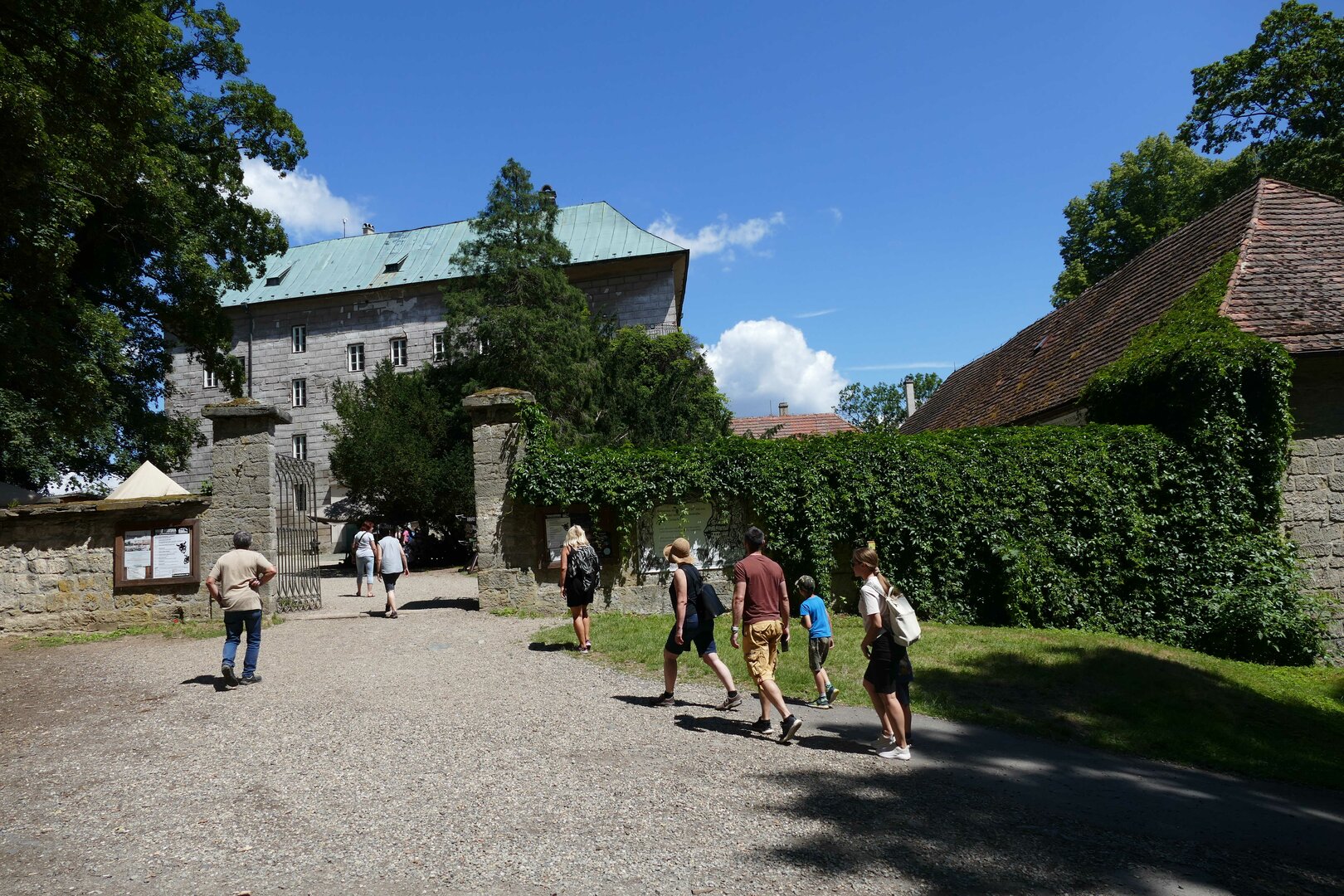
Despite the loss of its fortifications, Houska remains one of the most well-preserved castles founded by King Přemysl Otakar II. Although the internal layout of the palace buildings has changed over time, much of the original Gothic structure has survived up to the second floor, together with numerous architectural details. The painted decor of the castle chapel and the 'Green Chamber' are also particularly valuable. One of the castle’s most unusual features is a rock that runs through the entire building and can be seen both in the courtyard and inside. The courtyard has excellent acoustics, making Houska a popular venue for concerts.
Houska Castle also attracts visitors with its mysterious legend of a gateway to hell. According to local folklore, the entrance is guarded by a black monk. Its exact location remains a mystery - some place it beneath the chapel, others beneath the well, leaving plenty of room for the imagination.
The castle was first opened to the public in 1999 and 90% of it has now been restored.
.jpg)
.png)
.png)
.png)
.png)
.png)

.png)


